The EFQM Model
A model for finding best practices in HR work
Basics of the EFQM model
Meaning
The model of the European Foundation for Quality Management, or EFQM model for short, is based on European values, which were already defined in 1953 in theEuropean Convention on Civil Rights
and in the 1996 revisedEuropean Social Charter
have been established. In particular, the UN Global Compact with its ten principles has influenced the EFQM model - excellent organizations respect these rules and adhere to them, regardless of legal obligations.
Components for corporate success
The EFQM model uses three components to recognize sustainable corporate success and to provide food for thought, ways and means:
1. What - eight principles as the basic concept of excellence (value framework)
As part of a holistic approach to excellence:
- create benefits for customers and,
- shaping the future sustainably.
In order to achieve this:
- develops the capabilities of the (own) organization,
- Creativity and innovation encouraged,
- with vision, inspiration and integrity.
As a result:
- Changes not only endured, but actively managed,
- the success of the company is understood as the success of its employees,
- which aims to achieve outstanding results in the long term.
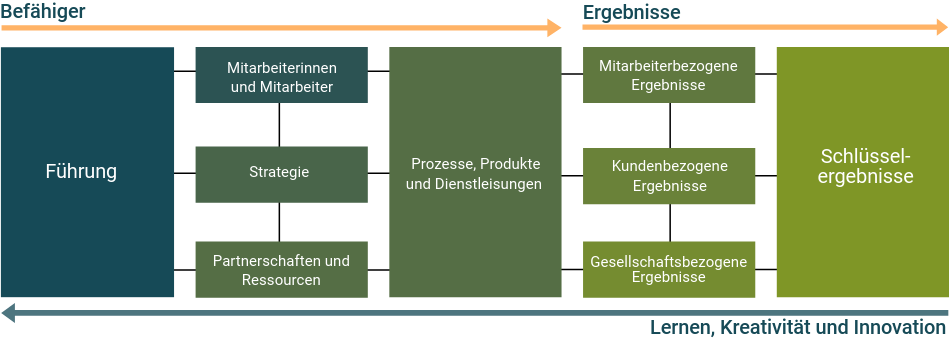
2. How/by what & for what? - nine criteria for implementing excellence
The question of theHow to achieve excellence
is answered by the criteria model with its nine main requirements and 32 sub-requirements, which are divided into two basic areas,Enablers
(who/what) andResults
(for what) can be subdivided. These have a reciprocal effect on each other - enablers enable results, results are the starting point for possible improvements of the enablers. The more dynamic the enablers, the more dynamic the results.
Enablers are measured against five criteria:
- Managers with vision, creative drive and creative competence,
- the company's own strategy is aligned with the interest groups through guidelines, plans and processes,
- Appreciating and motivating employees, developing their skills and promoting fairness and equality,
- manage partnerships, supply processes and resources to ensure that the impact on the environment and society is managed effectively,
- actively design, manage and improve their own portfolio of processes, products and services in order to create value for customers and other stakeholders.
Very good and outstanding, lasting results are recorded in four areas:
- operational and strategic results,
- Needs and expectations of their customers,
- Needs and expectations of employees,
- Needs and expectations of society and its shareholders and stakeholders.
3. With what? - Synthesis of principles and criteria + RADAR logic for checking excellence
Finally, the RADAR logic is used as an evaluation tool to check which criteria are used to successfully implement the eight principles of the value framework. The acronym RADAR (Results, Approach, Deployment, Assesment & Refinement) is based on results that are to be achieved (Results), derives procedures from these (Approach) and leads to their systematic implementation (Deployment). Finally, the results achieved are analyzed in order to generate learning effects and implement improvement measures.
The EFQM model provides a large number of reference points for this purpose. For the first enabler criterion "Leadership", there are already 31, divided into the five respective sub-aspects specified by the EFQM model.
EFQM model adaptation 2019
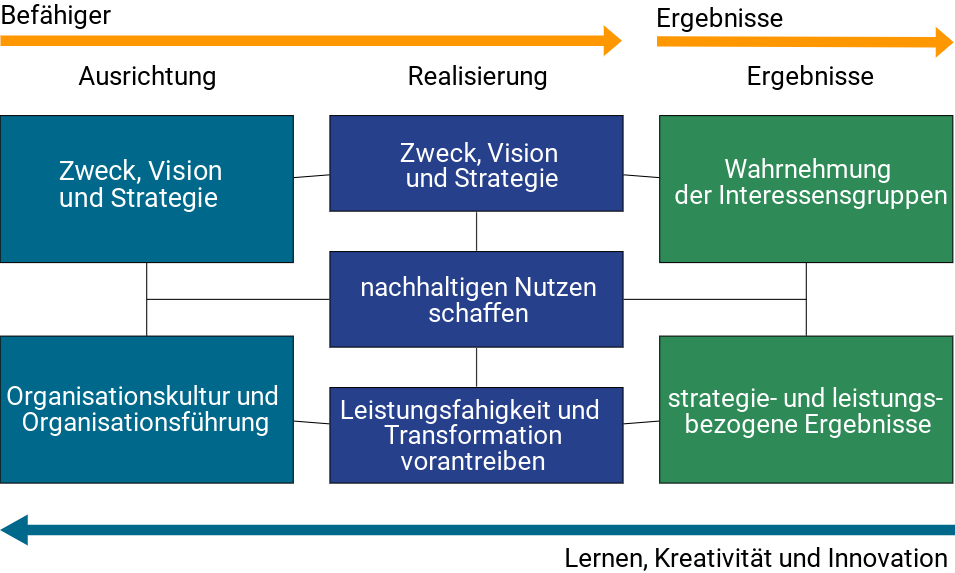
in 2019, the EFQM model was revised and published in an adapted version. The inclusion of current topics, other terms and a different view of trends should enable a more modern reflection on excellent organizations. The 2019 model can also be divided into three main areas:
1. What - Two criteria as an idea of excellence
The fundamental characteristic of excellent organizations is an inspiring purpose or a desirable vision, implemented through an effective strategy. In the course of the revision of the EFQM model, this first set of criteria replaces or corresponds to the eight basic concept principles of the 2013 EFQM model.
2. How/with what? - three criteria for implementing excellence
The EFQM model assumes that the action imperatives of excellent organizations are quite similar. There are specific interest groups with individual priorities whose sustainable benefit is of crucial importance for excellent organizations.
3. For what? - two criteria for verifying excellence
The 2019 EFQM model also groups results in terms of how they are perceived by the stakeholders involved, as well as strategy and performance-related results.
Faire-Karriere.de and EFQM
Context
The Faire-Karriere.de maturity model is an adapted version of the EFQM model that focuses on seven criteria. It focuses on excellent HR work with the aim of balancing the needs of the HR-relevant interest groups organization, management, employees, employee representatives, customers, partners and the environment.
Faire-Karriere offers participating organizations the opportunity to evaluate themselves and others. Participating interest groups (managers, employees, employee representatives, partners and customers) can assess an organization according to the seven criteria of Faire-Karriere.de and thus express their view of the maturity level.
Faire-Karriere.de Self-assessment
With the help of the self-assessment, each organization can determine its level of maturity and progress towards an excellent HR organization and compare it with the external assessment. This allows targeted improvement measures to be derived.
Faire-Karriere.de Maturity level
The maturity level of HR management is determined for each of the seven principles of Faire-Karriere.de by answering the following questions:
- Does your company have a specific procedure for this?
- Is this approach justified and based on the needs of all relevant interest groups?
- Does this procedure support the strategy and is it interlinked with other relevant procedures?
- Is this procedure based on processes and clear responsibilities, and is it planned in terms of time and deadlines?
- Has this procedure been introduced in all relevant areas of the company?
- Are the efficiency and effectiveness (key figures, feedback) of the procedure and its implementation regularly measured, evaluated and discussed in an appropriate manner?
- Has the procedure been improved or further developed in the last 3 years through analyses or innovations?
Conclusion
As part of the revision of the underlying EFQM model in 2019, the question arose as to whether the Fair Career Model also needed to be revised and adapted to the new EFQM model. However, the differences in content between the two EFQM models are (in our opinion) too small for a complete revision of the Fair Career Model to be necessary. The individual thematic blocks and criteria of the EFQM model can be merged quite easily. The graphical scheme from 2019 is also quite easy to reproduce in the design of the model from 2013. We are therefore of the opinion that the tried-and-tested fair career model continues to make sense.